When I think of the most beautiful hiking regions in Europe, the Alps are always high on my list. So I was especially excited to explore a highlights version of the Tour du Mont Blanc with Travelbase, one of Europe’s most famous long-distance hiking trails.
Over five days, I hiked through France, Italy and Switzerland, crossing high mountain passes, walking through flower-filled alpine meadows, passing small mountain lakes and glaciers, and taking in incredible views of the Mont Blanc massif along the way. And while the scenery is obviously the biggest highlight of the trip, what surprised me most was just how much the landscape changes from day to day. Just when I thought I had got used to the scenery in one country, the trail would suddenly look completely different again.
In this post, I’ll take you along on my five days on the Tour du Mont Blanc, share the individual stages and my personal highlights.
For transparency: This post about the Tour du Mont Blanc contains advertising links, also known as “affiliate links.” These links take you to products or services that I personally recommend. If you make a booking through one of these links, I receive a small commission. This support helps me continue to provide blog posts, photos, and videos free of charge. There are no additional costs for you.
table of contents
Tour du Mont Blanc in 5 days
The Travelbase tour is not the full Tour du Mont Blanc, but rather a five-day highlights route that brings together some of the most beautiful sections of this famous long-distance hiking trail. With up to 1,290 metres of elevation gain in a single day, it’s definitely a physical challenge but one that comes with some pretty incredible views.
Travelbase organises the trip as a self-guided trek, which means you get the best of both worlds: the important logistics are taken care of, while you’re free to hike at your own pace. They organise the route, transfers, accommodation and daily briefings, and you can also opt for luggage transfers from one hut to the next.
You can find the latest dates for the Tour du Mont Blanc with Travelbase here.
Day 1 of the Tour du Mont Blanc
Day 1 at a glance:
- Les Contamines-Montjoie → Les Chapieux
- 17 km
- 1.290 m ascent
- 940 m descent
- 7 hours of hiking time
The first hiking day on the Tour du Mont Blanc is definitely a bit of a challenge. With 17 kilometres and almost 1,300 metres of elevation gain, the route doesn’t exactly ease you into the adventure.
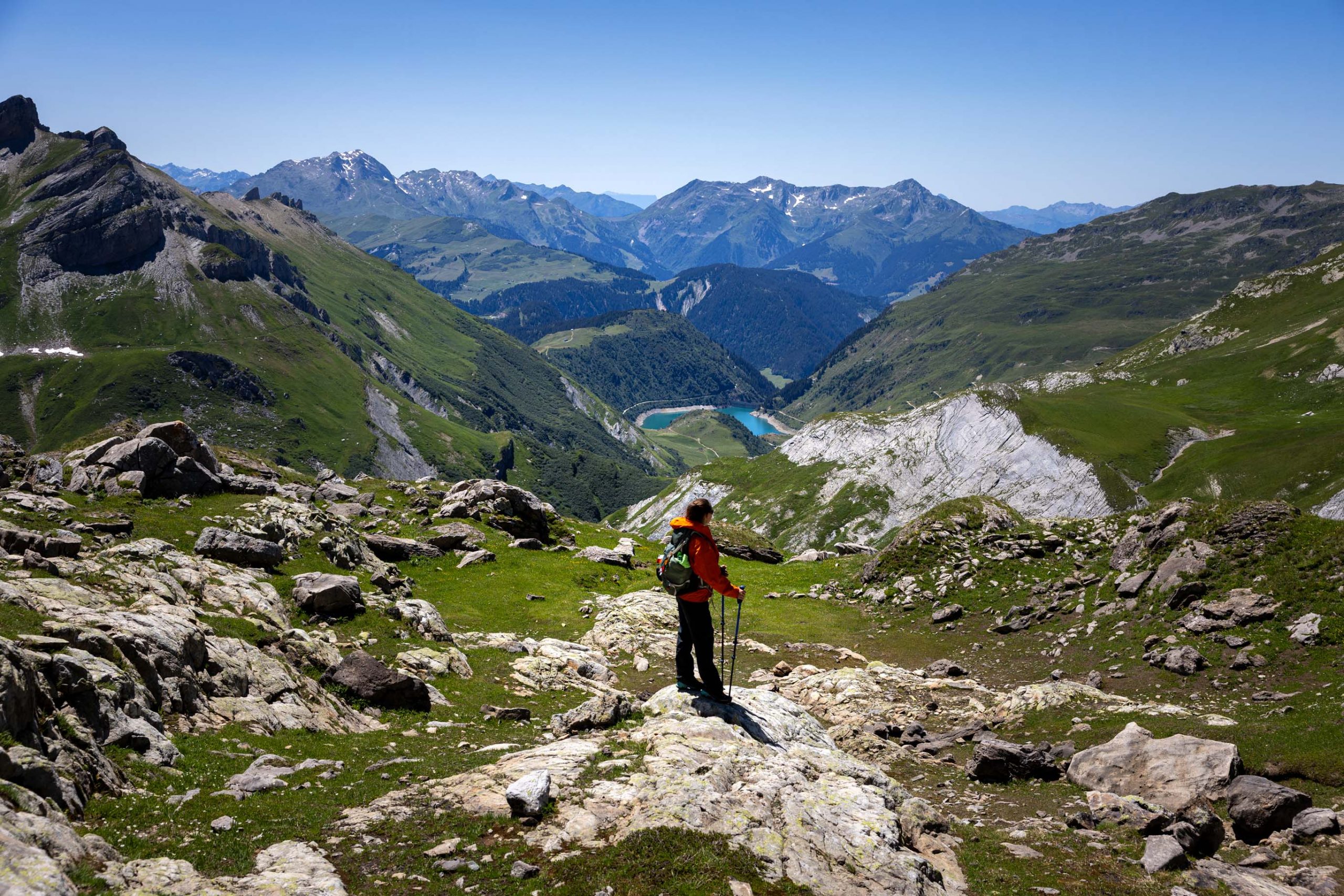
But in return, you immediately get a taste of what the next five days have in store: flower-filled alpine meadows, small mountain lakes, rugged peaks and constantly changing views of the surrounding mountains. At times, I almost feel like I’ve stepped into the Sound of Music, only with a lot more climbing involved.
Our route first takes us up to the Col du Bonhomme at 2,329 metres, before continuing to the Col de la Croix-du-Bonhomme at 2,483 metres. Up here, the wind really picks up, so make sure you have your hardshell jacket with you!
If you’re hiking this stage yourself, make sure to bring your own lunch and plenty of snacks. The mountain huts along the route stop serving food in the afternoon and they take that rule pretty seriously. You can probably imagine our disappointment when, at 3 pm, we realise we can’t even get a bowl of soup.
That said, the Travelbase Meal Pack actually comes in pretty handy. It includes dehydrated meals, a camping stove and a cooking pot, so you can prepare your own food along the way. I’m a little sceptical about the camping food at first, but I’m genuinely surprised by how good it is. And really, with views like these, everything tastes better anyway.
In the evening, instead of staying in a traditional mountain hut, we spend the night at a small boutique hotel down in the valley. A really good dinner and a hot shower are waiting for us, exactly what I’m craving after 17 kilometres and almost 1,300 metres of climbing.
Day 2 of the Tour du Mont Blanc
Day 2 at a glance:
- Les Chapieux → Courmayeur
- 18 km
- 780 m ascent
- 1.050 m descent
- approx. 6 hours of hiking time
If I had to pick a favourite day on the Tour du Mont Blanc, this would definitely be it. Not long after setting off, the scenery becomes increasingly dramatic, with some sections offering incredible 360-degree views of the surrounding mountains. After the fairly demanding first day, today’s stage feels almost a little more relaxed.
One of my personal highlights is a short detour to a mountain lake. The extra walk is definitely worth it, as the lake sits beautifully surrounded by mountains. And as if the scenery weren’t enough, we even spot an ibex along the way.
These are exactly the kind of moments I love about hiking: you’re simply making your way from A to B, and then suddenly you find yourself standing in the middle of this incredible landscape, wishing you could just stay there forever.
Today also brings our first border crossing. Via the Col de la Seigne, we hike from France into Italy. Once we reach the top, the perspective changes completely. Ahead of us lies the Italian side of the Mont Blanc massif, and on a clear day, you can spot peaks including Mont Blanc de Courmayeur, the Grandes Jorasses and the Noire de Peuterey.
That’s one of my favourite things about this tour: you can start the morning in France, cross the border into Italy on foot, and just a few hours later be sitting somewhere in the Italian Alps enjoying a meal. Three countries in five days already sounds special on paper, but out on the trail, it feels even more surreal.
- Speichere Dir den Post auf Deinem Pinterest Board

Day 3 of the Tour du Mont Blanc
Day 3 at a glance:
- Courmayeur → La Fouly
- 16 km
- 830 m ascent
- 1.000 m descent
- approx. 6 hours of hiking time
After two days on the Tour du Mont Blanc, today takes us from Italy into Switzerland. We don’t start directly in Courmayeur, though, Travelbase first takes us by shuttle to the Val Ferret. And honestly, the scenery here barely feels like Europe anymore. It reminds me so much of Canada. Or at least what I imagine Canada to look like, since I’m still yet to make it there. 😅
From the Val Ferret, the next climb begins. The trail first leads us up to the Refuge Elena at 2,052 metres, before continuing towards the Grand Col Ferret at 2,537 metres. Once we reach the top, we cross the border and leave Italy behind. After France and Italy, Switzerland becomes the third country of our tour.
And by this point, I honestly start to lose track of which country we’re actually in. But that’s also exactly what makes the Tour du Mont Blanc so special: within just a few days, the scenery is constantly changing and you keep crossing into a new country.
On the Swiss side, the trail leads through lush green mountain meadows down towards La Fouly. And if you think of Switzerland, this landscape is pretty much exactly what you’d imagine: bright green pastures, cows, small mountain villages and wild mountain rivers, all surrounded by an impressive alpine backdrop. After the more dramatic scenery of the first two days, this section feels wonderfully peaceful and idyllic.
La Fouly is a small mountain village at around 1,600 metres above sea level. The campsite is right next to a glacial river, and the mountain hut serves a surprisingly good three-course dinner with fresh salad, curry and chocolate mousse for dessert. Honestly, not a bad way to end another day of hiking.
One thing I definitely learned on this stage: be careful with your phone data in Switzerland. Because of all the border crossings and sections of the trail close to the Swiss border, my phone bill unfortunately ended up being a little higher than planned. I forgot to switch off data roaming in time a couple of times, which meant my German mobile provider automatically charged me for a daily roaming pass – twice.
So if you’re doing the Tour du Mont Blanc, I’d definitely recommend getting an eSIM for Switzerland and switching off your regular data roaming as soon as you get close to the Swiss border.
For eSIMs, I still really like using the Saily app. As a new customer, you can use my code TREATS at checkout to get 15% off all plans.
Day 4 of the Tour du Mont Blanc
Day 4 at a glance:
- La Fouly → Trient
- 16,5 km
- 780 m ascent
- 900 m descent
- approx. 6 hours of hiking time
After three days on the Tour du Mont Blanc, I slowly start to settle into a routine, and my body seems to know exactly what’s coming: get up, have breakfast, pack my backpack, start hiking, climb a few hundred metres, take a break, keep hiking, eat, sleep. And then do it all over again the next morning.
Today’s stage first takes us along a small mountain road, past traditional Swiss chalets and through a few tiny hamlets. From there, the trail continues through forests and across green meadows towards the Col de la Forclaz.
For me, this is probably the least spectacular stage in terms of scenery compared to the others. That doesn’t mean it isn’t beautiful, though, the Tour du Mont Blanc simply sets the bar incredibly high on the other days. The climb through the forest is pretty steep in places, but once we reach the top, we’re rewarded with another beautiful view of the surrounding mountains.
From there, the trail continues down into the Trient Valley, where we reach our destination for the day. And slowly, it starts to sink in that tomorrow really is already our final day on the trail.
Day 5 of the Tour du Mont Blanc
Day 5 at a glance:
- Trient → Chamonix
- 13 km
- 1.030 m ascent
- 1.000 m descent
- approx. 5 hours of hiking time
It’s our final hiking day on the Tour du Mont Blanc, and of course the route has saved a few special moments for the grand finale. From Trient, we start with another fairly steep climb. After the past four days, I can definitely feel all those elevation gains in my legs by now, but knowing that this is our last day on the trail gives me one final boost of motivation.
As we make our way out of the Trient Valley, we get another glimpse of the Trient Glacier before the final major climb begins, taking us up to the Col de Balme at 2,191 metres. And by the time we reach the top, I’m once again reminded why every single metre of climbing is worth it.
Waiting for us at the top is one of my personal highlights of the entire tour: the view of Mont Blanc. The timing could hardly be better. The weather is absolutely perfect, so we stop for lunch with a direct view of the Mont Blanc massif. It’s hard to imagine a better setting for a lunch break.
The mountain hut at the Col de Balme is definitely not the cheapest place to stop for a break, but the hosts are lovely and, with views like these, it’s pretty easy to justify spending a little more on a coffee, some food or a drink.
From there, the final section takes us steadily downhill towards Tré-le-Champ. With a total of 1,030 metres of ascent and 1,000 metres of descent, the last day is anything but an easy walk. Still, it feels a little different: you know the finish is getting closer with every step, so you find yourself enjoying those final hours on the trail even more consciously.
The trek officially ends at Montroc-Le-Planet train station, where the Travelbase rangers are waiting for us for a short debriefing, a little finisher gift and our train tickets to Chamonix. From here, it’s about a 30-minute train ride into town and suddenly, after five days of hiking through three countries, we’re back in civilisation.
And honestly, it’s a pretty great place to finish. Chamonix is beautiful, although noticeably more touristy and expensive than the small mountain villages along the trail. But after five days of hiking, I’m definitely not complaining about swapping my hiking boots for an Aperol and a proper meal.
How is the Tour du Mont Blanc with Travelbase organised?
The Tour du Mont Blanc with Travelbase is a self-guided trekking trip. This means you hike each stage independently and can choose your own pace and breaks, while Travelbase takes care of much of the organisation that comes with a multi-day trek.
Before the trip, you receive all the information you need to prepare, including a detailed packing list. Through the Travelbase app, you also have access to the individual stages, the route and other useful information about the trek. On site, the Travelbase Rangers give you a briefing each morning before you set off and are available if you have any questions along the way.
Personally, I really liked this balance: the important logistics are taken care of, but once you’re out on the trail, you still have the freedom to hike independently and enjoy the experience at your own pace.
However, if you’re expecting a traditional group tour where you hike with the same group and a guide every day, it’s important to know that this isn’t how the trip works. Of course, you’ll regularly meet other Travelbase participants, but ultimately, you hike each stage independently, using the Travelbase app or hiking apps such as Komoot for navigation.
Where do you stay on the Tour du Mont Blanc?
With the Tour du Mont Blanc by Travelbase, you can choose between camping and staying in huts. I opted for the hut option because, after a long day of hiking, I’m honestly quite happy to have a proper bed and a hot shower waiting for me.
That said, it’s worth knowing that the accommodation doesn’t always match the classic image of a high-altitude alpine mountain hut. Most of the places we stay are down in the valleys, and some feel more like small, simple hotels than traditional mountain huts.
If that classic mountain-hut experience with direct views of the surrounding peaks is particularly important to you, the camping option might actually be more appealing. Some of the campsites are in beautiful locations right in the middle of the mountains, and you can often start hiking straight from the campsite in the morning instead of taking one of the shuttles that Travelbase organises on certain days.
Looking back, that’s actually one of the reasons I’d be tempted to try the camping option if I did the tour a second time. It would probably feel a little more like the alpine adventure I had imagined when I first thought about hiking the Tour du Mont Blanc.
Luggage transfer on the Tour du Mont Blanc
On this Travelbase tour, I used the luggage transfer service from one accommodation to the next, which meant I only had to hike with my daypack each day. Including 2–3 litres of water, my backpack weighed around 7 kilograms. With stages involving up to 1,290 metres of elevation gain, I was definitely grateful for every kilo I didn’t have to carry.
For me, the luggage transfer made a huge difference. It meant I could focus on the hike and the scenery instead of carrying all my belongings across the Alps for five days. I would definitely book this option again.
How difficult is the Tour du Mont Blanc?
Travelbase rates the tour as difficult, and in my opinion, that’s a fair assessment. I didn’t find the trail particularly technical, but physically, it is definitely demanding.
Depending on the stage, you’ll hike between 13 and 18 kilometres, with some days involving more than 1,000 metres of elevation gain. On top of that, you’re hiking for five days in a row, so the effort definitely adds up. By the end of each day, I’m usually pretty exhausted.
But for me, that’s also part of what makes the experience so rewarding. If you hike regularly and feel comfortable taking on a physical challenge, I would absolutely recommend the five-day tour. In my opinion, you don’t need previous alpine experience, but you should be aware that this is not a relaxed hiking holiday.
How much does the Tour du Mont Blanc with Travelbase cost?
Cost: The Travelbase tour starts at €595 per person
Included:
- 5 nights at campsites in France, Italy and Switzerland
- Toilets and showers (except on the second night)
- Tourist taxes
- All internal shuttle transfers
- Train journey from Montroc-Le-Planet to Chamonix
- Support from the Travelbase Rangers
- Travelbase app
- Detailed route information and preparation tipsOptional extras:
Mountain hut option: from €425
- 5 nights in mountain huts
- 4 dinners
- Breakfast at the huts
Meal Pack: from €44
- 5 meals, including one fresh packed lunch
- With the camping option, 5 additional breakfasts, including one fresh breakfast
- Cooking pot and gas stove
Luggage transfer: from €145
For me, the luggage transfer was definitely the optional extra that was most worth it. If you’re deciding between camping and staying in huts, though, I’d think carefully about what kind of trekking experience you’re actually looking for.
My personal conclusion on the Tour du Mont Blanc
The five days on the Tour du Mont Blanc showed me one thing in particular: you don’t necessarily need two weeks to get a good taste of what this famous long-distance trail is all about. The highlights route is physically challenging, incredibly varied in terms of scenery, and takes you through three countries in just five days.
What I loved most was how different the landscape felt from one day to the next. From French alpine meadows and dramatic mountain passes to the Italian side of the Mont Blanc massif and those picture-perfect Swiss valleys, there was something new to take in every single day. And honestly, I found myself stopping to think “wow” more times than I could count.
The Dolomites are still very high up on my personal list, but the Tour du Mont Blanc has definitely earned its place among my favourite hiking experiences in Europe.
And if you’d like to read more of my blog posts, check out my post about a beautiful hike in the Bavarian Forest. Or find out what the Spreewald has to offer and discover the 6 best experiences for your short break in the Spreewald.